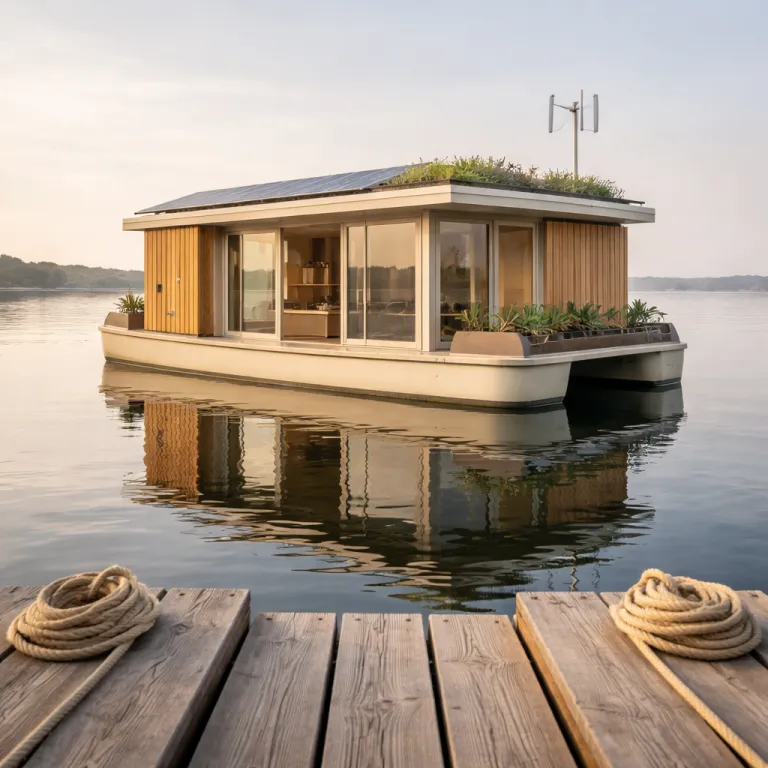
Off grid houseboat sustainable living as real luxury, not marketing
On Lake Union in Seattle, one floating house quietly rewrites what luxury means. Here, off grid houseboat sustainable living is not a slogan but a technical brief, where every litre of water, every watt of solar power and every gram of waste is tracked with the precision of a city infrastructure plan. For travellers browsing premium houseboats and floating homes, this shift from decorative eco styling to measurable performance is the new benchmark for true sustainable living.
Houseboat H, designed by architect Michelle Lanker with co designer Bill Bloxom, is a LEED Platinum certified solar houseboat that operates entirely off the grid while improving the surrounding life in the water. The project uses a 100 percent net zero energy system, combining extensive solar panels, large capacity batteries and energy efficient appliances to create a powered houseboat that never needs shore power yet maintains the comfort level of high end homes. According to the design team’s published data in the LEED project profile and AIA award documentation, the roof mounted array is reported at roughly 30 kilowatts and generates in the same annual range as a compact land based family house, and monitoring logs released by the owners indicate that grid backup has not been required during normal operation.
In a market where many powered houseboats offer only token eco gestures, Houseboat H treats renewable energy and conservation practices as the core of its design rather than an optional upgrade. The hull supports floating islands that act as tiny homes for aquatic species, turning the boat into a catalyst for biodiversity rather than a burden on the lake. A visiting guest described “waking up to clear water and schools of fish under the bedroom window” in a local design magazine feature, a small but telling sign that the environmental impact gap between this vessel and conventional houseboats floating on diesel generators and constant shore power cables is impossible to ignore for any traveller who cares about life on and under the water.
How a LEED Platinum floating home actually works off the grid
To understand off grid houseboat sustainable living in practice, you need to look beneath the clean timber cladding and calm reflections. Houseboat H is a net zero floating home, meaning it produces as much energy as it consumes over the year, and it does so while sitting entirely on water with no permanent land connections. As the designers explain in the project documentation, "A home that produces as much energy as it consumes, located on water," a concise summary later echoed in regional AIA award coverage and the LEED project profile.
The roof is a working surface, packed with a solar photovoltaic array reported at around 30 kilowatts that feeds a lithium ion battery bank sized at roughly 1 000 kilowatt hours, enough solar power storage to run the house for days without sun. Based on typical Seattle solar yields cited in the design team’s performance summaries, that array can produce in the order of 30 000 to 35 000 kilowatt hours per year, closely matching the recorded annual consumption of the all electric systems. This solar powered setup drives everything from induction cooking in the kitchen to heating in the living room, eliminating the need for diesel generators that usually define life on a traditional houseboat. For guests, the experience is simple quiet power, stable Wi Fi and hot showers, but behind the scenes the grid independent system constantly balances energy flows to keep the powered houseboat running smoothly.
Water systems are equally sophisticated, with rainwater capture, filtration and careful management of grey and black water to protect the lake. Floating islands attached to the hull create new aquatic habitats, which is why the project documentation notes that Houseboat H improves local water quality and biodiversity rather than degrading them. When you read climate research that now treats floating homes as experimental adaptation strategies, and you see neighbourhoods like Schoonschip in Amsterdam sharing energy, water and waste systems across 46 homes, it becomes clear that this style of eco friendly design is not a niche experiment but a serious model for future life on water.
For travellers curious about why living on water matters for climate resilience, the broader context of floating architecture is explored in depth in this analysis of living on water as climate strategy. Houseboat H sits within that movement, but it raises the bar by proving that powered houseboats can be both indulgent and rigorously sustainable. When you step aboard as a guest, you are entering a working prototype of how tiny houses and larger floating homes might function in coastal cities facing rising seas.
Performance snapshot (owner reported)
• PV capacity: ~30 kW rooftop array
• Battery storage: ~1 000 kWh lithium ion bank
• Annual solar generation: ~30 000–35 000 kWh
• Reported grid use: 0 kWh in typical years of monitored operation
From solar panels to life water systems: what travellers should look for
When you scroll through listings of luxury houseboats, the language around eco credentials can blur into one soft green haze. Off grid houseboat sustainable living, however, has specific technical markers that you can and should verify before you book your next floating stay. Think of it as reading a wine label, but for energy, water and environmental impact rather than grape varietals.
Start with power, because energy systems define both comfort and emissions on any boat or floating home. A genuinely solar powered houseboat will list the size of its solar panels in kilowatts, the capacity of its batteries in kilowatt hours and whether it still relies heavily on shore power or diesel backup during normal operation. Look for hosts who explain how their powered houseboats offer continuous electricity for heating, cooking and the living room without running noisy generators, and who can show that renewable energy covers most of their annual demand, ideally with simple charts or a brief performance summary drawn from monitoring data.
Water and waste systems are the second pillar, and they matter as much as the energy story for true sustainable living. Ask whether rainwater is captured and filtered, how grey water is treated before it returns to the lake or canal and whether composting or advanced treatment is used for black water to reduce pollution. The most advanced eco friendly houseboats floating today, such as Houseboat H, go further by integrating floating islands that enhance life in the water, turning the hull into a tiny conservation project rather than a passive object.
If you want a deeper technical primer before choosing between tiny homes on pontoons, larger floating homes or experimental concepts like the Arkup luxury vessel, this guide to the eco houseboat revolution is a useful reference. It explains how solar houseboat systems, rainwater harvesting and advanced insulation work together to reduce environmental impact without sacrificing comfort. Armed with that knowledge, you can read between the lines of marketing copy and focus on measurable conservation practices rather than vague promises.
Costs, comfort and the reality of sustainable luxury on water
There is no way around it, off grid houseboat sustainable living at LEED Platinum level is not the cheapest route to a night on the water. The infrastructure that allows a house to float, generate its own energy, manage its own water and support aquatic life adds significant upfront cost compared with a conventional houseboat plugged into shore power. For travellers, that translates into higher nightly rates, but also into a very different kind of stay.
On Houseboat H, the premium you pay supports a full scale renewable energy system rather than marble finishes or oversized televisions. The 30 kilowatts of solar panels, the 1 000 kilowatt hour battery bank and the advanced filtration systems are invisible luxuries, delivering silence, clean air and the satisfaction of knowing your stay has a low impact on the lake. In practice, that means you can cook in a full kitchen, work in a bright living room and sleep with only the sound of water against the hull, without the background hum of a generator or the visual clutter of cables.
By contrast, many standard houseboats offer attractive interiors but still rely on constant shore power and frequent pump outs, shifting the environmental impact to the marina infrastructure rather than eliminating it. The gap between eco certified floating homes like Houseboat H and the general fleet is wide, and it is worth paying attention to when you choose where to stay. In interviews with operators of similar net zero vessels, typical nightly rates are reported at 20 to 40 percent above comparable conventional rentals, reflecting capital expenditure on solar, batteries and treatment systems that can easily run into the mid six figures, yet many guests report that the quieter experience and lower footprint justify the additional cost.
For a sense of how these choices intersect with broader market forces, the analysis of the houseboat market surge shows how sustainability is shaping demand worldwide. As more travellers seek eco friendly options, operators investing in solar power, advanced water systems and floating habitat restoration are likely to stand out. Over time, that should help bring the cost of off grid systems down, making this level of sustainable living more accessible across different sizes of houseboats and tiny houses on water.
How to read a listing: separating real sustainability from greenwashing
Once you know what off grid houseboat sustainable living looks like in practice, the next step is learning how to spot it in a booking listing. Many hosts now mention solar, eco features or low impact design, but the level of detail varies wildly and so does the actual performance. Your goal as a traveller is to decode the language and focus on verifiable systems rather than soft adjectives.
Start with structure and design, because the way a house floats tells you a lot about its environmental impact. Listings for serious floating homes will often mention insulation levels, window performance and hull design, all of which affect energy demand and therefore the size of the solar power system required. If a host simply writes that the house is eco friendly without explaining how the boat manages heating, cooling and power, you are probably looking at a conventional houseboat with a few efficient appliances rather than a true solar houseboat.
Next, examine the description of water and waste systems, which should be as clear as the energy story if the property is genuinely sustainable. Look for references to rainwater capture, filtration, on board treatment of grey and black water and any measures taken to protect life in the water around the hull. When a listing mentions floating gardens, habitat creation or partnerships with local environmental organisations, as in the case of Houseboat H, it signals a deeper commitment to conservation practices than a simple recycling bin in the living room.
Finally, consider scale and context, because off grid systems behave differently on tiny houses, larger houseboats and experimental vessels like Arkup that can lift themselves above the waves. Tiny homes on pontoons may achieve impressive efficiency with modest solar panels, while bigger powered houseboats need more roof area and battery capacity to stay off the grid. The most credible hosts will explain these trade offs openly, sometimes even linking to design portfolios or manufacturer datasheets, helping you choose between compact houseboats floating in quiet marinas and more expansive floating homes that feel like full sized houses on water.
From Lake Union to Arkup: where off grid floating life is heading
Houseboat H on Lake Union is not an isolated curiosity, but part of a broader shift toward off grid houseboat sustainable living across different regions and price points. In Amsterdam, the Schoonschip neighbourhood shows how 46 floating homes can share energy, water and waste systems, turning a canal into a micro grid rather than a static backdrop. For travellers, these projects hint at a future where staying on water means participating in a living laboratory of climate adaptation rather than simply renting a quirky boat.
At the high end of the market, concepts like Arkup blend yacht scale engineering with floating home comfort, promising solar powered autonomy and minimal environmental impact in coastal waters. While not every Arkup style vessel operates as a fully off grid powered houseboat yet, the design direction is clear, with large solar panels, battery banks and advanced stabilisation systems becoming standard. As these technologies mature, you can expect more listings where houseboats offer the quiet confidence of renewable energy and robust water systems as part of the baseline, not as optional extras.
For solo explorers and design conscious travellers, this evolution opens up a new category of stays that sit somewhere between tiny houses, architect designed homes and expedition ready boats. You might spend one trip in a compact solar houseboat moored in a sheltered bay, another in a LEED certified floating home that improves local biodiversity and a third on a semi mobile vessel that can move between anchorages without leaving a heavy wake. Across all of these, the common thread is a commitment to conservation practices, careful management of life water systems and a design language that treats the grid as optional rather than essential.
As more destinations embrace floating architecture as part of their climate strategy, the choices available on premium booking platforms will only deepen. The challenge for travellers will be to keep asking precise questions about energy, water and impact, rewarding the operators who match the quiet rigour of Houseboat H rather than those who rely on vague eco claims. In doing so, you help steer the market toward a future where sustainable living on water is not a niche experiment but a refined, widely accessible way of life.
FAQ
What makes a floating home like Houseboat H truly off grid ?
A floating home is genuinely off grid when it can operate without permanent connections to municipal electricity, water or sewage systems under normal conditions. Houseboat H achieves this with a large solar power array, substantial battery storage, rainwater capture, on board filtration and advanced waste treatment, allowing it to function as a self contained house on water. The result is a powered houseboat that maintains comfort while keeping its environmental impact very low.
How does Houseboat H improve local water quality and biodiversity ?
Houseboat H integrates floating islands around its hull, which act as habitat for aquatic plants and animals and help filter the surrounding water. These structures create sheltered zones where microorganisms and small species can thrive, gradually improving clarity and overall life in the water. This approach contrasts with traditional land reclamation, which often damages ecosystems, and shows how houseboats floating in sensitive areas can support conservation practices.
What does LEED Platinum certification mean for a houseboat stay ?
LEED Platinum is the highest level of certification in the Leadership in Energy and Environmental Design system, indicating exceptional performance in energy efficiency, water management, materials and indoor environmental quality. For guests, staying in a LEED Platinum floating home like Houseboat H means the house has been independently assessed against strict criteria rather than relying on self declared eco labels. It also signals that the design prioritises long term sustainable living, not just short term comfort.
Are off grid solar powered houseboats more expensive to rent ?
In most markets, fully off grid solar powered houseboats do command higher nightly rates than conventional houseboats that rely on shore power and standard marina services. The price reflects the cost of installing and maintaining large solar panels, battery banks, filtration systems and other infrastructure required for grid independent living. Many travellers consider the premium worthwhile for the quieter experience, lower environmental impact and the chance to support operators investing in serious sustainability.
How can I verify sustainability claims when booking a houseboat ?
When reviewing listings, look for specific data on solar capacity, battery storage, water treatment methods and any third party certifications such as LEED or local eco labels. Hosts who provide clear numbers, explain how their systems reduce environmental impact and describe conservation practices around the hull are usually more credible than those using only general eco friendly language. If details are missing, do not hesitate to ask direct questions about energy, water and waste before confirming your booking.